In short
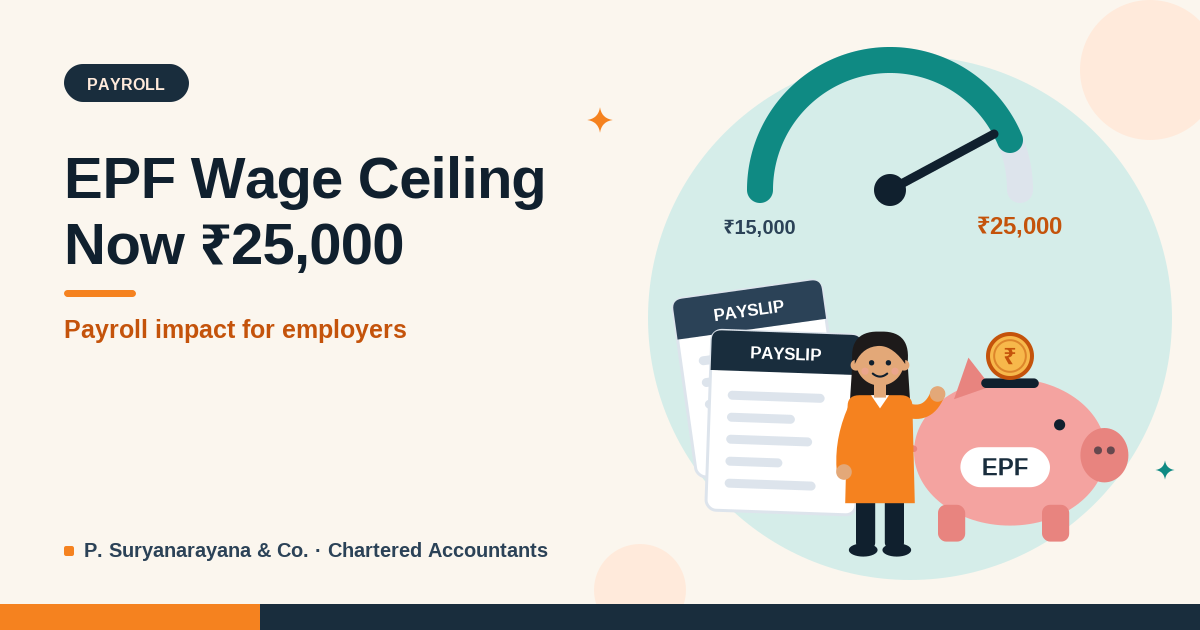
The wage ceiling for mandatory provident fund coverage has risen from ₹15,000 to ₹25,000 a month under notification S.O. 5109(E). Employers must enrol employees with PF wages between ₹15,001 and ₹25,000 who were outside PF, raise any contribution cap to the new ceiling, and review CTC structures where the employer contribution is part of pay.
Key takeaways
- Mandatory PF coverage now extends to employees earning up to ₹25,000 a month.
- Employees earning ₹15,001–₹25,000 who were outside PF must be enrolled.
- Employers capping contributions at the old ceiling must revise the cap.
- Employer PF cost rises where PF is part of CTC — salary structures may need review.
In this article3 min read
What changed
By notification S.O. 5109(E) dated 17 September 2026, issued under the Code on Social Security, 2020, the wage ceiling for mandatory provident fund coverage has been raised from ₹15,000 to ₹25,000 per month. This follows the EPF Scheme, 2026, notified on 29 June 2026, which replaced the EPF Scheme, 1952 under the Code.
Who is affected
Two groups of employees are affected. First, employees earning between ₹15,001 and ₹25,000 who joined without PF because their pay exceeded the old ceiling now come within mandatory coverage. Second, existing members whose contributions were restricted to ₹15,000 will see contributions calculated on a higher base, up to ₹25,000.
Worked example
Consider an employee with PF wages (basic plus dearness allowance) of ₹22,000 a month who was not a PF member. At the standard 12% rate, the employee now contributes ₹2,640 a month and the employer contributes a matching amount, part of which is allocated to the pension scheme as prescribed. Where the employer contribution is built into CTC, the employee's take-home pay falls unless the structure is revised.
Payroll checklist
Work through these steps before running the next payroll.
- List employees with PF wages between ₹15,001 and ₹25,000 who are not members
- Generate or link UANs and complete KYC for newly covered employees
- Update contribution caps in the payroll system to the new ceiling
- Confirm the effective date and any pro-rata treatment in the notification
- Recompute CTC and communicate changes to affected employees
- Deposit contributions and file the ECR by the 15th of the following month
Watch the wage definition
Under the Code on Social Security, 'wages' has a uniform definition: where allowances excluded from wages exceed half of total remuneration, the excess is added back. Splitting pay into allowances to keep PF wages low is now harder to sustain and is a common inspection issue.
Frequently asked questions
Can an employee earning ₹20,000 opt out of PF?
+
Employees within the wage ceiling are mandatorily covered. Opt-out is generally available only to employees above the ceiling at the time of joining, subject to the scheme's conditions.
Does the change affect ESI?
+
No. ESI has its own wage limit for coverage, which is unaffected by the PF wage ceiling.
Legal basis
- Notification S.O. 5109(E) dated 17 September 2026
- EPF Scheme, 2026 (G.S.R. 525(E), 29 June 2026)
- Code on Social Security, 2020
Last updated . General information only, not professional advice. Laws and dates change — confirm the current position before acting.