In short
A private limited company's first auditor is appointed by the Board within 30 days of incorporation; after that, shareholders appoint the auditor at the AGM, generally for five years, and the company files ADT-1 within 15 days. Choose a chartered accountant or firm that is eligible and independent under sections 141 and 144 of the Companies Act, 2013, and that has the experience, team and availability your audit needs.
Key takeaways
- The Board appoints the first auditor within 30 days of incorporation; shareholders appoint later auditors at the AGM.
- A regular appointment runs from one AGM to the conclusion of the sixth AGM, generally five years.
- Obtain the auditor's written consent and eligibility certificate before the appointment, and file ADT-1 within 15 days.
- The firm that keeps your books or does your internal audit cannot also be your statutory auditor.
In this article4 min read
Who appoints the auditor, and when
The first auditor of a company is appointed by the Board of Directors within 30 days of registration and holds office until the conclusion of the first annual general meeting. If the Board does not appoint one, the members appoint the first auditor at an extraordinary general meeting within 90 days.
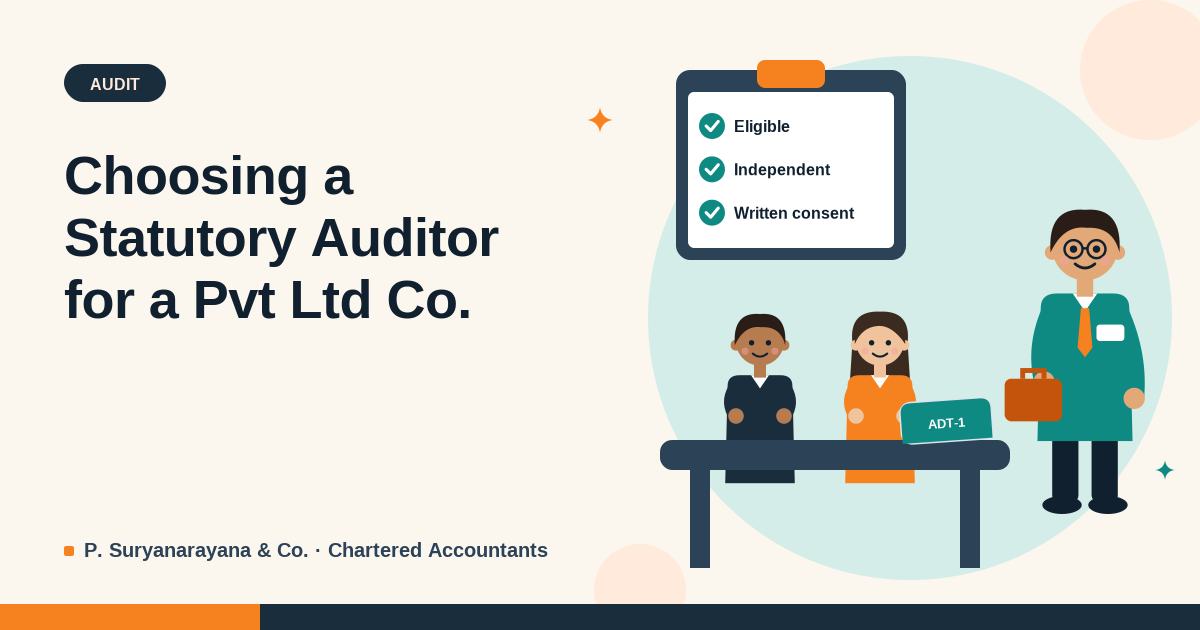
At the first AGM, the shareholders appoint an auditor to hold office from the conclusion of that meeting until the conclusion of the sixth AGM, in practice a five-year term. Before the appointment, the company obtains the auditor's written consent and a certificate that the appointment meets the eligibility conditions, and it files Form ADT-1 with the Registrar within 15 days of the meeting at which the auditor is appointed.
Mandatory rotation of auditors under section 139(2) applies to listed companies and the classes of companies prescribed in the Companies (Audit and Auditors) Rules, 2014. Many smaller private companies fall outside it, but check the current thresholds before assuming so.
Who is eligible
Only a chartered accountant in practice, or a firm (including an LLP) in which a majority of the partners practising in India are chartered accountants, can be appointed. Section 141 disqualifies, among others:
- A body corporate other than an LLP
- An officer or employee of the company, or a partner or employee of such a person
- A person who, or whose relative or partner, holds securities in or is indebted to the company beyond the prescribed limits
- A person with a business relationship with the company of a kind the rules restrict
- A person whose relative is a director or key managerial person of the company
- A person in full-time employment elsewhere, or who already holds more than twenty company audits (one person, dormant, small and certain private companies are excluded from the count)
Independence: services the auditor cannot provide
Section 144 prohibits the statutory auditor from providing certain services to the company, directly or indirectly, including accounting and book-keeping, internal audit, design and implementation of financial information systems, actuarial services, investment advisory and investment banking services, outsourced financial services and management services.
If the firm that maintains your books is a chartered accountancy practice, it cannot also be your statutory auditor. Appoint a separate, independent firm for the audit.
What to look for when choosing
Eligibility is the minimum. Beyond it, compare candidates on:
- Experience with companies of your size and industry, and with CARO 2020 reporting where it applies
- The team who will actually do the work, and how involved the engagement partner will be
- Familiarity with your accounting software, including the audit trail (edit log) requirement
- Availability to complete the audit well before the AGM and filing deadlines
- A clear engagement letter covering scope, timelines, information requests and fees
Changing auditors mid-term
An auditor can be removed before the end of the term only by a special resolution of the company, after obtaining the prior approval of the Central Government and giving the auditor a reasonable opportunity of being heard.
An auditor who resigns must file Form ADT-3 with the Registrar within 30 days. The Board fills the resulting casual vacancy within 30 days, and because the vacancy arose from a resignation, the appointment must also be approved by the shareholders at a general meeting within three months.
Frequently asked questions
Who appoints the first auditor of a new private limited company?
+
The Board of Directors, within 30 days of incorporation. If the Board does not, the shareholders appoint the first auditor at an extraordinary general meeting within 90 days.
Can the accountant who maintains our books also be our statutory auditor?
+
No. Section 144 of the Companies Act, 2013 prohibits the statutory auditor from providing accounting and book-keeping services to the company.
How long is a statutory auditor appointed for?
+
An auditor appointed at an AGM holds office from the conclusion of that meeting until the conclusion of the sixth AGM, generally five years. Limits on reappointment apply only to companies covered by the rotation rules in section 139(2).
Can we change our auditor before the term ends?
+
Removal before the term ends needs a special resolution and the prior approval of the Central Government. If the auditor resigns instead, they file Form ADT-3 and the Board fills the casual vacancy, subject to shareholder approval.
Legal basis
- Companies Act, 2013 — sections 139 to 141 and 144
- Companies (Audit and Auditors) Rules, 2014
Last updated . General information only, not professional advice. Laws and dates change — confirm the current position before acting.